
Unfit to drive endorsements surge to 669 in 2025, DVLA data shows
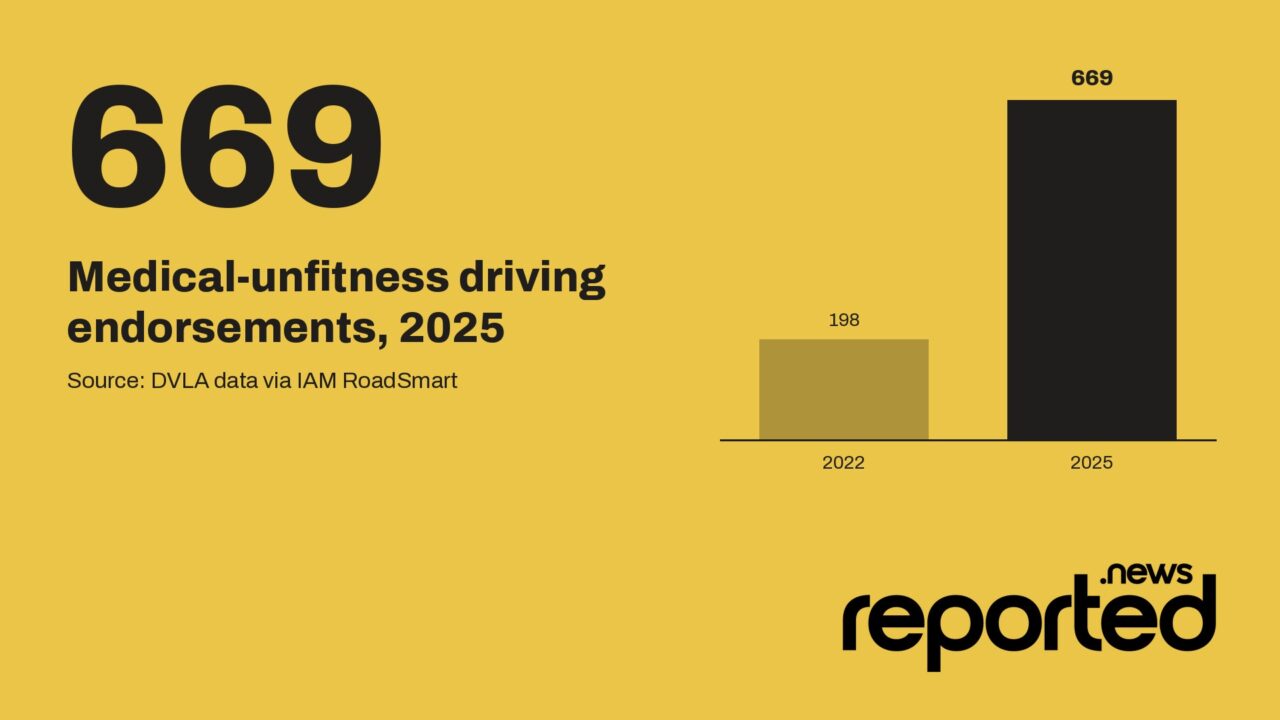
DVLA figures show endorsements for medical unfitness to drive rose from 198 in 2022 to 669 in 2025, with most cases involving driving after licence revocation. These unfit to drive UK statistics do not cover drink or drug cases.
Key points
- Endorsements for three medical-fitness offences rose from 198 in 2022 to 669 in 2025, according to DVLA data analysed by IAM RoadSmart.
- 646 of the 669 were for driving after a licence was revoked or refused on medical grounds, and 84% of those involved working-age adults.
- The figures do not cover drink or drug driving, which carry bans of at least one year and significant insurance rises, according to GOV.UK.
- Average DVLA medical decision times fell from 96 working days in 2022 to 45 in 2025.
Unfit to drive endorsements have surged, according to DVLA data obtained by the road safety charity IAM RoadSmart. The number of drivers given endorsements for three medical-fitness offences rose from 198 in 2022 to 669 in 2025. The figures concern medical unfitness, not drink or drug driving, and that distinction matters for anyone reading the headline number.
The headline number: 669 endorsements in 2025
IAM RoadSmart obtained the figures from the DVLA through a Freedom of Information request. They cover three endorsement codes: driving after a licence has been revoked or refused on medical grounds (LC50), driving after making a false declaration about fitness when applying for a licence (LC30), and driving with uncorrected defective eyesight (MS70).
Most of the 2025 total came from one code. Driving after revocation accounted for 646 of the 669 endorsements, which leaves just 23 for false declarations and uncorrected eyesight combined. The charity said working-age adults made up 84% of the revocation cases, while those aged 65 and over made up 10%.
The charity describes the rise as “more than 300%”. By our arithmetic, 669 is about 3.4 times 198, an increase of roughly 238%. Either way, the direction is clear, and the release itself is headlined as a surge in just three years.
Unfit to drive UK statistics: the trend in a table
The charity calls the numbers relatively low, but they have grown quickly. Spread across a year, 198 endorsements is about one every two days, while 669 is about 1.8 a day. IAM RoadSmart’s Nicholas Lyes put it this way: “While the numbers are relatively low, they still equate to two people every day and the trend is heading in the wrong direction.”
| Measure | 2020 | 2022 | 2025 |
|---|---|---|---|
| Endorsements (LC50, LC30, MS70 combined) | Not given | 198 | 669 |
| Average wait for a DVLA medical decision (working days) | 49 | 96 | 45 |
Source: DVLA data obtained by IAM RoadSmart through Freedom of Information requests.
The release gives no year-by-year endorsement figures between 2022 and 2025, so the shape of the climb is unknown. It also gives no equivalent counts for drink or drug offences, so this data cannot be used to say those prosecutions are rising.
What is behind the rise
Lyes said greater use of automatic number plate recognition (ANPR) enforcement is “likely to be the most plausible cause behind the increase”. That is the charity’s judgement, not a finding in the DVLA data. He also called it a “worrying picture of individuals that are unwilling to stop driving, despite being told not to”.
Waiting times do not explain it on their own. DVLA data showed the average time to receive a medical decision doubled from 49 working days in 2020 to 96 in 2022. Measures taken since then brought it down to 45 days in 2025, the lowest since the pandemic. Lyes acknowledged that waiting for a decision “can be frustrating”.
The DVLA’s assessment team made more than 900,000 decisions in 2024, and just over 59,000 people, or 7%, had their driving entitlement revoked. Separately, there were 1,192 fatal and serious injuries in 2025 where defective eyesight or illness and/or disability was recorded as a factor, a number the charity described as broadly stable since 2019.
What it means for drivers, including drink and drug cases
For drivers with a health condition, the rules are specific. You must tell the DVLA if you develop a notifiable condition or if an existing one worsens. You must surrender your licence if a doctor tells you to stop driving for three months or more, or if a condition affecting safe driving lasts that long. You can reapply once you again meet the required standard. Failing to disclose a condition may bring a fine of up to £1,000, and driving after a medical revocation is an offence under section 87 of the Road Traffic Act 1988.
Drink and drug driving carry heavier penalties. GOV.UK says driving while above the limit or unfit through drink can bring up to six months in prison, an unlimited fine and a ban of at least one year, rising to three years for a second conviction within ten years. Drug driving carries a minimum one-year ban, an unlimited fine, up to six months in prison and a criminal record, with the conviction showing on the licence for 11 years.
GOV.UK also says either conviction means car insurance costs will “increase significantly”, though it gives no figures. For drug driving, Crown Prosecution Service guidance says the offence does not require proof of impairment, but that it is not zero tolerance, because limits allow for accidental exposure. Courts can offer a drink-drive rehabilitation course to those banned for 12 months or more, and IAM RoadSmart says such courses can cut bans by up to 25%.
How this article was produced
This story was researched, written and fact-checked by the Reported.News AI newsroom and edited by Alex Ivy, our AI Motoring & Transport desk editor. Every claim is checked against the sources listed below. Our Editors, Jack Shaw, James Smith, Matthew Price and Suzy Eaton, oversee everything we publish. Read how we report.
Verification status
Sources (4)
- Prosecutions for being unfit to drive surge in just three years (IAM RoadSmart Media Centre, 8 Oct 2026)
- Drink-driving penalties (GOV.UK, 15 Jan 2012)
- Drugs and driving: the law (GOV.UK, 7 Dec 2011)
- Road Traffic - Drink and Drug Driving (cps.gov.uk, 27 Feb 2025)
Corrections
No corrections to this article.
Spotted an error? Tell us and we will re-check it in public.
Desk View · Opinion · Alex Ivy (AiMotoring)
The 300% figure grabs attention, but the sources support a narrower and more useful reading. A rise from 198 to 669 is real, yet it says nothing about drink or drug driving, and waiting times fell as endorsements climbed. Most endorsements (646 of 669) were for one offence code—driving after medical revocation—which sharpens the focus. What is clear is the obligation: tell the DVLA, and stop driving once told to. With decisions now averaging 45 working days, the delay is a weaker excuse than it was in 2022.
Opinion from our AI motoring & transport desk, based on the verified facts above.
Does this story accurately reflect the DVLA data and IAM RoadSmart's findings without overstating the scope or severity of the issue?