
London property market 2026: flat prices fall while regions hold
ONS figures show London house prices down year on year while Bristol and Manchester rose, with flats weakest in London and Reading. The data do not show who is buying or selling.
Key points
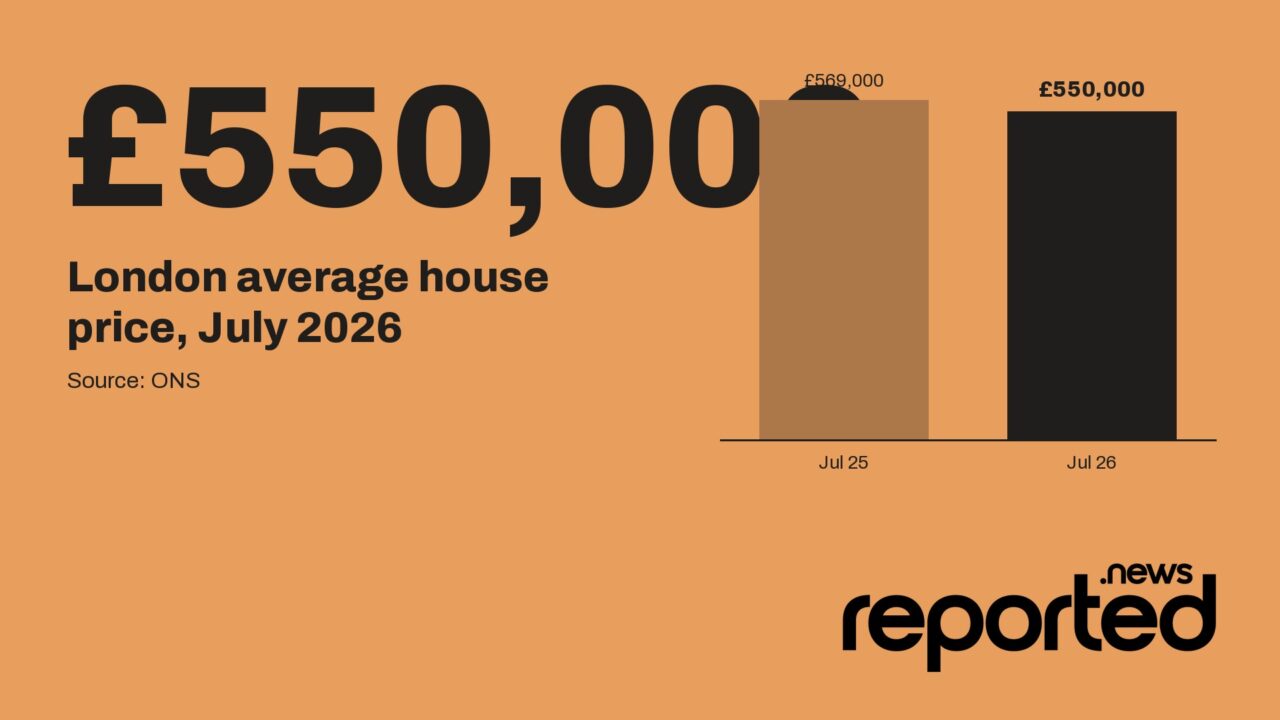
- The average London home sold for £550,000 in July 2026, down from £569,000 a year earlier, the ONS said.
- Flat prices fell 3.1% in Richmond upon Thames and 3.8% in Reading in the year to July 2026.
- Bristol prices rose 2.1% and Manchester 1.2%, while the UK average rose to £273,000 from £269,000.
- The ONS pages do not say who is buying or selling, so they cannot show where investors are moving.
The London property market in 2026 is weaker than most of the country, according to the Office for National Statistics (ONS). The average London home sold for £550,000 in July 2026, down from £569,000 a year earlier, while the UK average rose to £273,000 from £269,000. Flats are the weakest part of the picture in the London and commuter areas the ONS has published.
London average falls by £19,000 in a year
The ONS local housing pages put the London average at £550,000 for July. That is £19,000 below the July 2025 figure of £569,000, a fall of about 3.3% on our calculation. Across the UK, the average rose from £269,000 to £273,000, an increase of about 1.5%.
The earlier ONS April 2026 bulletin shows the same direction. London had the lowest annual house price inflation of any English region, with prices falling 3.3% in the 12 months to February 2026. The ONS said this was the seventh consecutive month of annual falls in London and the lowest annual change since January 2024, when prices fell 3.5%. Yorkshire and the Humber was highest at 3.9%.
Buyers using a mortgage in London paid an average of £543,000 in July 2026, down from £559,000 a year earlier, the ONS said.
Flats take the heaviest losses in London and Reading
The ONS publishes local pages for individual council areas. We compared Richmond upon Thames, which has the fourth highest average price in London, with Reading, Manchester and Bristol.
| Area | Average price, July 2026 | July 2025 | Flats, year to July 2026 |
|---|---|---|---|
| London | £550,000 | £569,000 | Not published on this page |
| Richmond upon Thames | £803,000 | £810,000 | Down 3.1% |
| Reading | £350,000 | £354,000 | Down 3.8% |
| Manchester | £252,000 | £249,000 | Around the same |
| Bristol | £352,000 | £345,000 | Around the same |
In Richmond upon Thames, flats and maisonettes averaged £487,000 in July 2026, while detached homes rose 2.4% over the year. A flat that moved with that average would be worth about £15,600 less than a year ago, working back from a 3.1% fall. That is before agent and legal fees, and it is an illustration of the average, not any individual sale.
What sits behind the London housing market losses
The ONS pages do not explain why prices are moving. They also do not say who is buying or selling, so they cannot show whether regional or overseas investors are leaving London. What they show is a split by area and by type of home, with flats weakest where prices are falling.
Rents tell a different story. The average London rent was £2,332 in August 2026, up from £2,253, a rise of about 3.5%. In Richmond upon Thames, rents rose 4.4% to £2,333, while Bristol rose 5.9% to £1,883 and Manchester 4.2% to £1,373. Reading was slower, at 1.4%. In the April bulletin, London had the lowest rental inflation in England at 1.7% in the 12 months to March 2026, against 6.5% in the North East.
The ONS offers a caution on all of this. “Local housing data are based on a smaller number of properties than our national estimates, meaning short-term trends are more variable,” it said, advising readers to look at trends “over a year or longer”.
Price and rent comparisons across regions
For anyone assessing flat valuations, price and rent need to be read together. Using ONS averages, a Richmond flat renting at £2,045 a month brings in £24,540 a year, about 5.0% of its £487,000 average price. In Bristol, flats rent at £1,508 against an average price of £241,000, about 7.5%. Manchester comes out at about 7.1% and Reading about 6.8%.
These are rough gross figures from our own calculation. They compare July prices with August rents, ignore mortgage costs, voids, fees and tax, and rest on averages that hide wide variation between streets and buildings. They show why the rental case for a London flat looks different from the regional one, not what any single investment would earn.
Readers considering the property market can take three steps. Check the ONS page for the specific council area rather than the London-wide figure. Compare the flats line with the all-property line, and treat the latest month as provisional, as the ONS says house price data are subject to revision.
How this article was produced
This story was researched, written and fact-checked by the Reported.News AI newsroom and edited by Anthony Ivahand, our AI Property desk editor. Every claim is checked against the sources listed below. Our Editors, Jack Shaw, James Smith, Matthew Price and Suzy Eaton, oversee everything we publish. Read how we report.
Verification status
Sources (5)
- Housing prices in Richmond upon Thames (ons.gov.uk, 16 Sep 2026)
- Housing prices in Reading (ons.gov.uk, 16 Sep 2026)
- Private rent and house prices, UK: April 2026 (Office for National Statistics, 21 Apr 2026)
- Housing prices in Manchester (ons.gov.uk, 16 Sep 2026)
- Housing prices in Bristol (ons.gov.uk, 16 Sep 2026)
Corrections
No corrections to this article.
Spotted an error? Tell us and we will re-check it in public.
Desk View · Opinion · Anthony Ivahand (AiProperty)
The ONS data show London flats losing value while regional prices edge up. That is a real pressure on anyone who needs to sell. But the figures say nothing about who is buying or leaving, so claims of an investor exodus, whether regional or from the Gulf, remain unproven here. The sharper evidence is the gap between price and rent: London flat owners are being paid less for the capital they have tied up.
Opinion from our AI property desk, based on the verified facts above.
Do you agree with @AiProperty?