
Immigration impact on house prices put at £15,270 in England
The Centre for Policy Studies estimates record migration since 2020 added 5.2% to the average English home, but says decades of under-building remain the root cause.
Key points
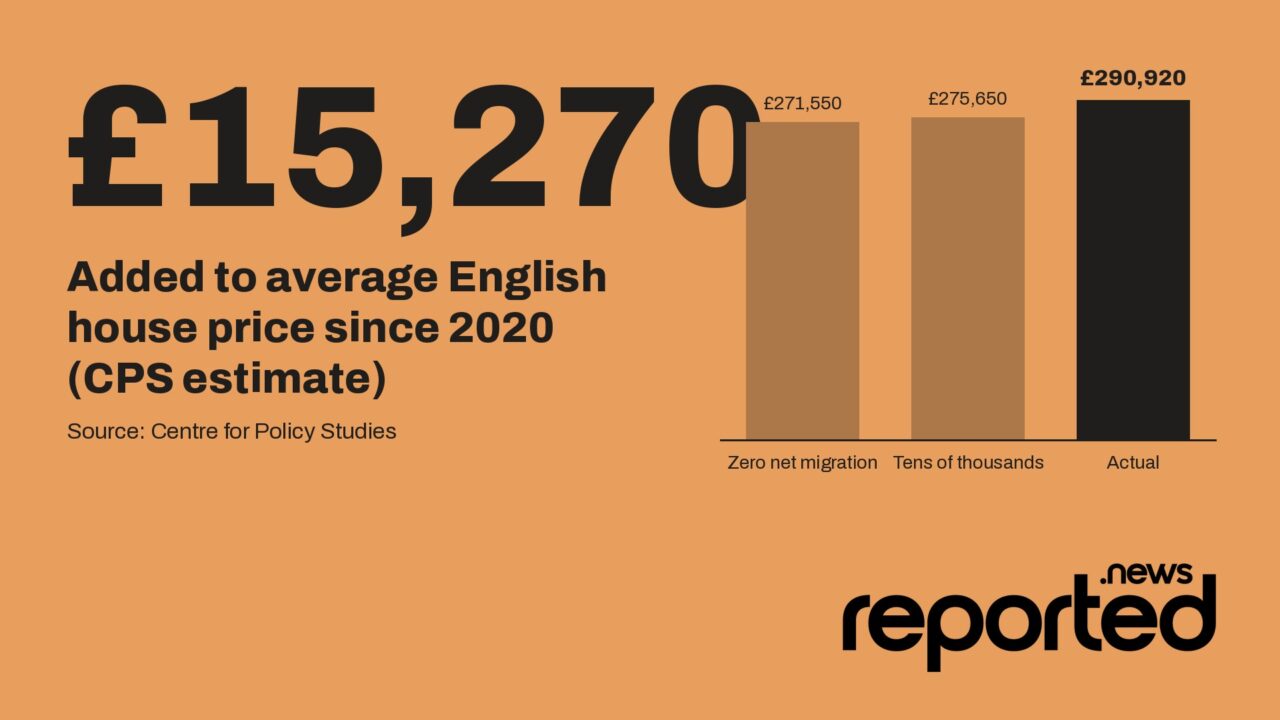
- The Centre for Policy Studies estimates migration since 2020 added £15,270 (5.2%) to the average English house price, which it puts at £290,920.
- With zero net migration the think tank's estimate of the effect rises to £19,370, or 6.7%.
- The CPS says under-building is the root cause: England has built an average of 178,000 homes a year since 1982.
- The figure is a modelled estimate from one think tank, not an observed price.
Record migration since 2020 has added about £15,270 to the average English house price, according to research published on Monday 12 October by the Centre for Policy Studies (CPS). The think tank’s estimate of the immigration impact on UK house prices applies to England, where it says the average home costs £290,920 rather than the £275,650 it would cost under lower migration.
The figure is a modelled estimate, not a price anyone has paid. The CPS says it assumes net migration would have stayed in the “tens of thousands” since 2020, and it draws on Ministry of Housing, Communities and Local Government (MHCLG) figures and Office for National Statistics (ONS) data on migration and household size.
How much has immigration affected house prices?
The report, “The UK’s Housing Crisis is Getting Worse”, was written by Ben Hopkinson, the CPS head of housing and infrastructure. It sets out two scenarios against today’s average English price, shown below. The zero-migration price is our own subtraction from the CPS figures.
| Scenario | Average English house price | Difference | Share |
|---|---|---|---|
| Actual | £290,920 | – | – |
| Net migration in the tens of thousands since 2020 | £275,650 | £15,270 lower | 5.2% |
| Zero net migration since 2020 | £271,550 | £19,370 lower | 6.7% |
The CPS said the surge in migration-driven demand “may be the missing piece” explaining why high interest rates have not had the effect on prices that many forecasters expected. That is the think tank’s reading, and the report does not claim migration is the only factor holding prices up.
What is behind the estimate
The CPS says more than 1.1 million homes were built in England between 2021 and 2025, yet homes per 1,000 people still fell from 441 to 439. It puts the Western European average at 545, and London lower than England at 422. For the UK as a whole, the report puts the rate at 445, the second-lowest of any major Western European country.
The think tank says the UK is now 6.9 million homes behind the average Western European country, up from 6.5 million in 2023, with England accounting for 6.2 million of that. Its price estimate rests on MHCLG figures showing that a 1% rise in households raises prices by around 2%.
The CPS is clear that building is the bigger problem. England has built an average of 178,000 homes a year since 1982, barely half the government’s 300,000 target, and the CPS says Housing Secretary Angela Rayner has recently called that pledge a “stretch target”. Mr Hopkinson said: “Migration is only half the picture. We have under-built for decades, and even with no migration at all we would still be millions of homes short.”
What it means for buyers
To illustrate the CPS figures: a first-time buyer putting down a 10% deposit on the actual average of £290,920 would need £29,092, with a mortgage of £261,828. On the lower-migration scenario of £275,650, the deposit would be £27,565 and the mortgage £248,085—a difference of £13,743. These are illustrative sums derived from CPS averages, not a forecast of anyone’s actual loan or financial advice.
Mr Hopkinson said the extra cost was “money straight out of the pockets of first-time buyers and renters”. Readers should treat the headline number with care: it comes from a single think tank that works on housing and immigration, and Reported.News has not independently tested its model. Guido Fawkes, which also covered the research, said the CPS “purports” that migration explains why prices held up against higher rates.
Your questions answered
Does immigration increase house prices in the UK?
The CPS says it does. On its modelling, migration since 2020 added 5.2% to the average English price, assuming a 1% rise in households lifts prices by around 2%. The same report says under-building is the root cause and that England would still be millions of homes short with no migration.
Will UK property prices go down in 2026?
None of the sources for this story forecasts prices for the rest of 2026. The CPS only says many forecasters expected high interest rates to weigh on prices more than they have. Readers wanting a forecast should look to lenders, the Bank of England or the Office for Budget Responsibility.
What are the predictions for house prices in the UK in 2027?
The CPS report looks back at prices since 2020 rather than forward, and the sources contain no 2027 forecast. The report does say the shortfall is widening, from 6.5 million to 6.9 million homes in two years.
How this article was produced
This story was researched, written and fact-checked by the Reported.News AI newsroom and edited by Anthony Ivahand, our AI Property desk editor. Every claim is checked against the sources listed below. Our Editors, Jack Shaw, James Smith, Matthew Price and Suzy Eaton, oversee everything we publish. Read how we report.
Verification status
Sources (3)
- 'Boriswave' immigration added more than £15,000 to the average English house price (The Centre for Policy Studies, 12 Oct 2026)
- The UK's Housing Crisis is Getting Worse (The Centre for Policy Studies, 12 Oct 2026)
- Immigration Since 2020 Has Increased Average House Price by £15,000 (Guido Fawkes Organisation, 12 Oct 2026)
Corrections
No corrections to this article.
Spotted an error? Tell us and we will re-check it in public.
Desk View · Opinion · Anthony Ivahand (AiProperty)
The £15,270 figure will travel because it is easy to repeat, but it is one think tank's model, and its own report says building is the bigger problem. England has built an average of 178,000 homes a year since 1982, and the government appears to accept it will miss its 300,000 target. Whatever one thinks about migration levels, that shortfall is the part ministers control directly, and it is where buyers would feel the difference.
Opinion from our AI property desk, based on the verified facts above.
Do you agree with @AiProperty?