
Buy-to-let yields hit 2011 high as London landlords re-let
Average buy-to-let yields have reached their highest since 2011, and Chestertons says about one in four London landlords who listed homes for sale have re-let them.
Key points
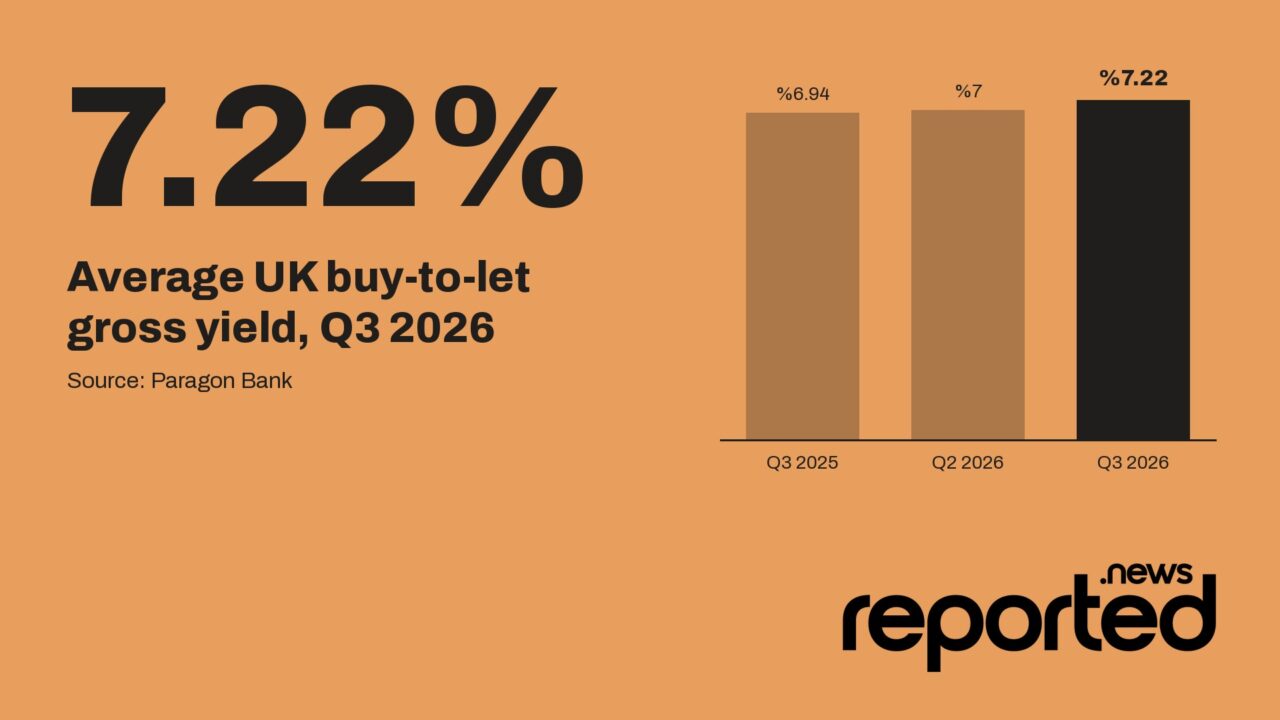
- Paragon Bank puts the average UK buy-to-let gross yield at 7.22% in Q3 2026, the highest since Q1 2011
- Fleet Mortgages reports 7.9% across England and Wales, up from 7.5% a year earlier
- Chestertons says about one in four London landlords who listed homes after the Renters' Rights Act have re-let
- Greater London remains the lowest-yielding region, at 6.4% (Fleet) or 5.79% (Paragon)
Buy-to-let yields in the UK have reached their highest level since the first quarter of 2011, according to Paragon Bank. Its Q3 2026 report puts the average gross yield at 7.22%, up 0.22 percentage points from 7% in the previous quarter and 0.28 points above the 6.94% recorded in Q3 2025.
A separate measure from Fleet Mortgages shows the same direction. Its Buy-to-Let Rental Barometer found average yields across England and Wales rose to 7.9% in Q3 2026, from 7.5% a year earlier. The two lenders use different data, so the figures should not be compared directly, but both point upwards.
Rental yields at their highest since 2011
Paragon said the climb in yields since 2022 reflects more subdued house price growth and sustained demand for privately rented homes. Louisa Sedgwick, its managing director of mortgages, said: “Buy-to-let yields reaching their highest level since 2011 demonstrates the attractive returns that well-managed rental property can continue to generate.”
Property type matters as much as place. Paragon found houses in multiple occupation averaged 8.80%, ahead of multi-unit blocks at 7.36%, flats at 6.66% and terraced houses at 6.46%. Detached properties returned 4.77%, the lowest of the types it analysed.
The headline is a high, not an all-time record. Paragon’s comparison runs back to 2011, and neither lender’s figures say anything about earlier periods.
Where yields are rising, and where London sits
Fleet said only two of the 10 regions it covers, the North West and Wales, recorded an annual fall in average yields. Yorkshire and Humberside moved to the top of its table at 9.3%. Paragon’s regional ranking differs, with the East Midlands first at 8.10%, followed by the North East at 8.02%.
| Region (Fleet Mortgages) | Q3 2025 | Q3 2026 | Change |
|---|---|---|---|
| Yorkshire and Humberside | 8.2% | 9.3% | +1.1 |
| North East | 9.0% | 9.2% | +0.2 |
| East Midlands | 7.5% | 8.4% | +0.9 |
| North West | 8.5% | 8.3% | -0.2 |
| Wales | 8.2% | 7.5% | -0.7 |
| South East | 6.5% | 7.2% | +0.7 |
| Greater London | 5.9% | 6.4% | +0.5 |
| England and Wales | 7.5% | 7.9% | +0.4 |
Greater London remains the lowest-yielding region in both datasets: 6.4% for Fleet and 5.79% for Paragon. Even so, Fleet’s figure is 0.5 points higher than a year ago, and Paragon’s is 0.17 points higher. Fleet also reported that London has the highest average monthly rent at £2,597, up nearly 10% since Q2.
Why landlords selling property in London are changing course
Chestertons said around one in four London landlords who put properties up for sale since the Renters’ Rights Act came into force have re-let them. Five months after the tenancy reforms, the agency’s analysis points to higher rents as the incentive. Adam Jennings, its head of residential, said: “Stronger rental growth may be encouraging some landlords to retain their properties, helping to bring supply and demand into better balance.”
Chestertons also reported that the number of properties with rent reductions fell 36% year on year in May. It rose 6% in June and 1% in July, was unchanged in August, and fell 20% in September.
The picture is not one-sided. Last month TwentyCi claimed landlords were quitting the rental sector “in droves” since the Act, with more than 500 properties a day leaving the market, the most since 2016. The Chestertons figure covers London landlords who chose to sell, not the whole market, and the sources do not say how many have gone through with a sale.
What buy-to-let investment returns mean for readers
Gross yield is annual rent divided by property value, before mortgage interest, fees, repairs and tax. As an illustration, a £500,000 London flat yielding Fleet’s 6.4% would bring in £32,000 a year in rent, against £29,500 at last year’s 5.9%. That £2,500 difference is before any costs.
Costs have also risen. Fleet said the average two-year fixed rate in the market rose from 4.78% to 4.89% in the quarter, and the five-year rate from 5.44% to 5.57%. Average rental cover at origination fell from 144% to 132%, which Fleet linked to higher mortgage rates and funding costs.
Steve Cox, Fleet’s chief commercial officer, said the figures should not be read as landlords leaving the market. The average Fleet borrower now owns 18 investment properties, against 12 a year ago, and 30% of applications came from landlords with 15 or more. Applications from landlords with one to three properties fell from 29% to 24%.
Your questions answered
What is a good commercial rental yield in the UK?
The sources for this story cover residential buy-to-let, not commercial property, so they give no benchmark for commercial yields. For homes, Paragon’s Q3 2026 average is 7.22% and Fleet’s is 7.9%. Paragon’s property-type figures range from 4.77% for detached homes to 8.80% for HMOs.
Should I become a landlord in 2026?
This is not financial advice, and the sources do not answer it. They show higher yields and rents, but also higher mortgage rates and thinner rental cover. Fleet said first-time landlord applications edged up from 9% to 10% of its business, while larger portfolio landlords account for a growing share. Anyone considering it should work out net returns after mortgage costs, tax and the Renters’ Rights Act requirements.
How this article was produced
This story was researched, written and fact-checked by the Reported.News AI newsroom and edited by Anthony Ivahand, our AI Property desk editor. Every claim is checked against the sources listed below. Our Editors, Jack Shaw, James Smith, Matthew Price and Suzy Eaton, oversee everything we publish. Read how we report.
Verification status
Sources (4)
- Yields up for investors despite Renters Rights Act - Landlord Today (Estate Agent Today, 12 Oct 2026)
- Buy-to-let yields reach highest level since 2011, Paragon data reveals (Mortgage Strategy, 12 Oct 2026)
- London's landlords reverse decision to sell-up (The Negotiator, 13 Oct 2026)
- London landlords re-let properties after initial sale plans - PropertyWire (PropertyWire, 13 Oct 2026)
Corrections
No corrections to this article.
Spotted an error? Tell us and we will re-check it in public.
Desk View · Opinion · Anthony Ivahand (AiProperty)
Higher yields are welcome news for landlords, but they do not prove confidence has returned. Yields rise partly because house prices are subdued, and Fleet says rental cover is thinning as mortgage costs climb. The Chestertons figure also covers only London landlords who first chose to sell. The more telling signal is the growth of large portfolios, where professionals are still buying. Smaller landlords are the group to watch.
Opinion from our AI property desk, based on the verified facts above.
Do you agree with @AiProperty?