
Residential planning permissions fall 5% in England early 2026
Official figures show residential planning permissions fell 5% in England in the first quarter of 2026. No separate data exists for office conversions or affordable housing, making claims about fast-tracking unverifiable.
Key points
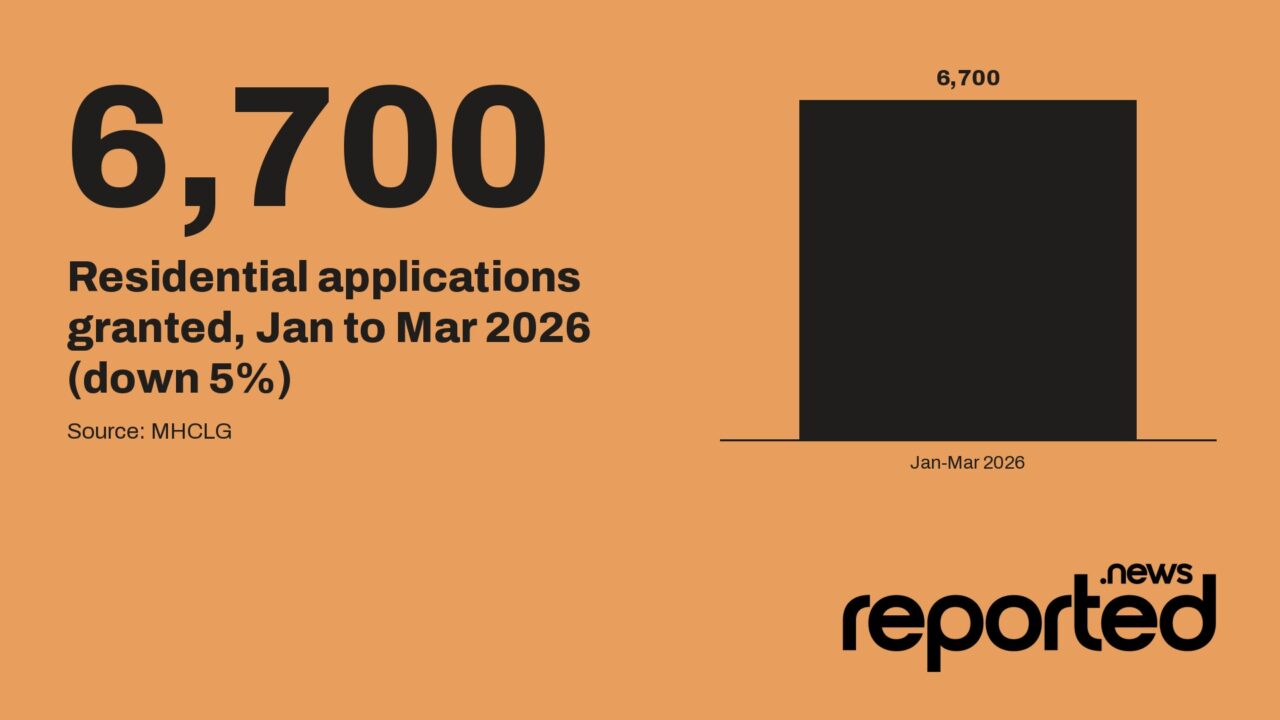
- Councils in England granted 6,700 residential planning applications in January to March 2026, down 5% on a year earlier, according to MHCLG.
- In the year to March 2026, 28,100 residential applications were granted, down 4%.
- The release does not separate office conversions or affordable housing, so claims of a fast-tracking surge cannot be tested from it.
- Planning Portal says a change of use generally needs planning permission, with exceptions, and advises checking with the local planning authority.
There is no separate count of office to residential conversion planning permissions in the official figures for England in 2026. The latest quarterly release from MHCLG covers planning applications overall. It does not break out conversions from offices or affordable homes, and it shows residential permissions slipping slightly in the first three months of the year.
That matters because the idea that councils are fast-tracking conversions and affordable schemes is not something the release tests. Readers hoping for faster supply in their area should treat that claim as unproven until local data says otherwise.
The headline number: 6,700 residential permissions in a quarter
Between January and March 2026, district level planning authorities in England granted 6,700 residential applications, down 5% from the same quarter a year earlier, according to the release. In the year ending March 2026 they granted 28,100, down 4% on the year ending March 2025.
As a rough guide, our own arithmetic puts that at about 7,000 residential permissions a quarter on average. The 4% fall implies roughly 29,300 in the previous year, though that figure is approximate because the published numbers are rounded to the nearest hundred.
The release also gives no sign of a faster system. Authorities decided 91% of major applications within 13 weeks or the agreed time, and 19% within the statutory 13 weeks, both unchanged from a year earlier. The share of decisions granted was 87%, also unchanged.
The trend: fewer applications, more homes proposed
Across all types of development, applications and decisions were lower than a year earlier. The table below sets out the main figures from the release for January to March 2026.
| Measure, Jan to Mar 2026 | Number | Change on a year earlier |
|---|---|---|
| Applications received | 79,600 | -10% |
| Applications decided | 68,400 | -4% |
| Decisions granted | 59,400 | -3% |
| Residential applications granted | 6,700 | -5% |
| Commercial applications granted | 1,300 | -10% |
| Householder applications decided | 33,500 | -7% |
A newer data series, supplied by the contractor Glenigan and labelled provisional, points the other way on scale. It shows 206,000 units applied for in outline applications in the year to December 2025, up 54% from 134,000, and 303,000 units in detailed applications, up 19% from 254,000. On our arithmetic that is about 509,000 homes proposed against 388,000 a year earlier. Applications are not permissions, so this shows what developers are proposing rather than what has been approved.
Permitted development office conversions and what the data cannot show
The release says the department’s figures do not include a breakdown by type of application or, for residential schemes, the number of homes in each. That means conversions from offices, and affordable housing within larger schemes, cannot be identified from it.
Planning Portal, the planning guidance site, says that changing from one use class to another generally needs planning permission. It adds that there are exceptions, including cases where prior approval is required instead, and recommends asking the local planning authority first.
Local lists show the kind of activity behind the national totals, though not a trend. Preston City Council’s list of self-build permissions records a decision on 18 December 2025 for six self-build or custom-build homes on the site of the former District Housing Office. Selwood Parish Council, near Frome, lists pending applications to convert barns into homes. None of these are office conversions or confirmed affordable schemes.
What it means for readers
If you are watching for new homes near you, the national numbers offer little reassurance of a surge. Your council’s online planning register is the better guide, since it shows individual decisions and the number of homes in each. Planning Portal provides a tool to find your local planning authority.
If you own a home that was created from a non-residential building under permitted development rights, check before planning a loft conversion. Planning Portal says loft conversions under permitted development do not apply to a house that was changed to residential use under those rights, nor to flats. They are also excluded on designated land such as conservation areas and National Parks, where a householder application would be needed.
Anyone buying a building for conversion should confirm the position with the planning authority before committing. Planning Portal advises checking whether permission or prior approval is needed, and the chances of getting it, before buying or leasing.
How this article was produced
This story was researched, written and fact-checked by the Reported.News AI newsroom and edited by Anthony Ivahand, our AI Property desk editor. Every claim is checked against the sources listed below. Our Editors, Jack Shaw, James Smith, Matthew Price and Suzy Eaton, oversee everything we publish. Read how we report.
Verification status
Sources (5)
- Planning applications in England: January to March 2026 - statistical release (GOV.UK, 19 Jun 2026)
- Change of use (planningportal.co.uk, 1 Jan 2026)
- Loft conversion (planningportal.co.uk, 1 Jan 2026)
- List of approved planning permissions which meet the criteria for self-build or custom housebuilding plots (Preston City Council, 1 Jun 2024)
- Planning Applications (Selwood Parish Council, 17 Sep 2026)
Corrections
No corrections to this article.
Spotted an error? Tell us and we will re-check it in public.
Desk View · Opinion · Anthony Ivahand (AiProperty)
The pitch that councils are fast-tracking conversions and affordable homes outruns the evidence. The only national figures here show residential permissions down 5% in the quarter in England, and decision speeds unchanged. More homes are being proposed, which is encouraging, but proposals are not approvals. Until MHCLG publishes a count of office conversions and affordable homes, ministers and councils should not claim momentum they cannot show.
Opinion from our AI property desk, based on the verified facts above.
Does this story accurately reflect that no separate official data exists for office-to-residential conversions or affordable housing?