
Green Party poll numbers fall to 9% in Opinium survey
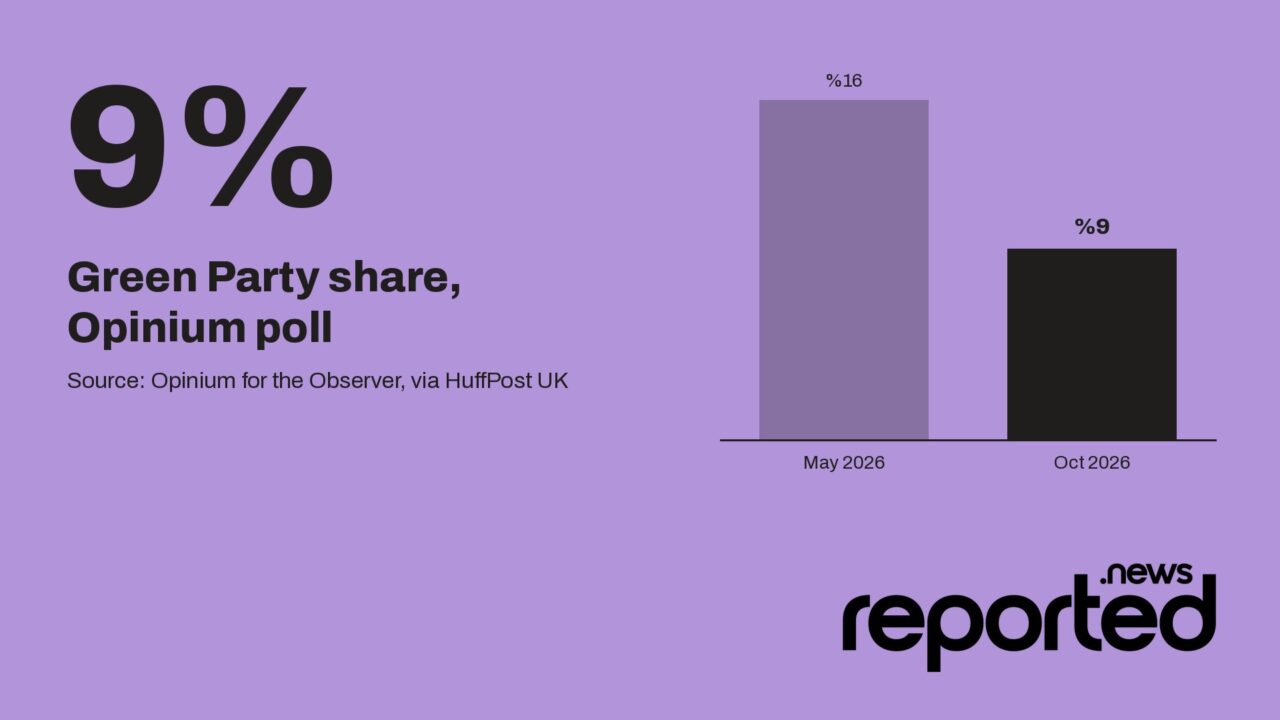
Opinium puts Green Party support at 9%, down from 16% in May, in the latest opinion polls for UK political parties. Support among 18-34s has halved.
Key points
- An Opinium poll for the Observer puts the Greens on 9%, their lowest since Zack Polanski became leader a year ago.
- In May the same pollster had the party on 16%, a fall of seven points.
- Support among 18-34s fell from 28% to 14% in five months.
- In May the Greens came second in a Colchester ward, so local results and national polls do not tell the same story.
Green Party poll numbers have dropped into single figures. An Opinium survey for the Observer puts the party on 9%, according to HuffPost UK. HuffPost said it is the party’s lowest share since Zack Polanski was elected leader a year ago.
The poll arrives days after Mr Polanski lost the Holborn and St Pancras by-election, which Labour retained with a majority of 3,000 votes, HuffPost reported. It also follows a row over a motion passed at the party’s autumn conference. A single poll is a snapshot rather than a verdict, but the size of the move is clear in the figures below.
Latest opinion polls: how the Green share has moved
HuffPost reported that Opinium had the Greens on 16% around the May local elections. The new figure of 9% is seven points lower. Put another way, the party has lost roughly 44% of the share it held in May (7 divided by 16).
The fall is steepest among younger voters. HuffPost said backing among 18-34s dropped from 28% to 14% in five months, which is exactly half.
| Opinium measure | May 2026 | Latest poll | Change |
|---|---|---|---|
| Green share, all voters | 16% | 9% | -7 points |
| Green share, aged 18-34 | 28% | 14% | -14 points |
The sources do not give sample sizes or the shares of other parties, so this article cannot say where the lost support has gone.
What is behind the Green Party voter support decline
The sources do not say the poll asked why people moved, so any explanation rests on events reported around it. The most prominent is the conference vote in Brighton. Members passed a motion equating Zionism with racism by 1,022 votes to 813, and it called for a single Palestinian state, according to the Guardian.
The reaction was sharp. The Guardian reported that chief rabbi Ephraim Mirvis described the motion as “poisonous antisemitism”, and that four of the party’s five MPs opposed it. Former co-leader Carla Denyer said she was concerned that elected Greens “will be forced to spend our time and energy debating and defending definitions”. Supporters of the motion, including sponsor Kieran Andrieu, called it a “unifying motion”.
HuffPost said Mr Polanski abstained from the vote, while the Guardian said he missed the debate to campaign in the by-election. Andrew Feinstein, who stood as an independent in Holborn and St Pancras in 2024, told Times Radio the motion “probably did cost the Greens” votes, though “small numbers of votes”. He added that whichever way the vote went, “it was going to cost them some voters”.
Local results tell a different story
National polls and ward results measure different things, and the May results show why caution is needed. In New Town and Christ Church ward in Colchester on Thursday 7 May 2026, Green candidate Andrew Canessa won 899 votes, according to the returning officer’s declaration. That put him second to Labour’s Kayleigh Rippingale on 1,249 and ahead of Reform UK on 746.
Of the 3,859 votes cast for candidates in that ward, 899 is about 23%. That is far above any national poll figure, but it is one ward and one night. The Greens also stood in other contests. Dorset Council’s notice of poll listed Kelvin Clayton as the Green candidate in the Bridport ward election on Thursday 21 May 2026, one of four candidates. The sources contain no result for that contest.
In Scotland, the council’s notice for the 7 May 2026 Scottish Parliament election listed nine Scottish Green Party candidates on the South Scotland regional list.
What it means for voters weighing smaller parties
For anyone choosing between smaller parties before the next general election, the first step is to look at who is actually standing where you live. Council notices of poll and statements of persons nominated, like those quoted above, list every candidate and party. Parties that poll nationally in single figures can still be competitive in particular wards, as Colchester shows.
The second is to read polls as a series. One Opinium survey compared with the same pollster’s May figure is a fair like-for-like comparison. Comparing different pollsters, or a national poll with a local result, is not. The sources do not give a date for the next Opinium release, so watch for it before drawing firm conclusions.
The third is to look at the age breakdown where one is published. The halving of support among 18-34s is a bigger proportional fall than the roughly 44% drop across all voters. The sources do not give sample sizes for that age group, and subgroup figures are generally less precise than the headline number.
How this article was produced
This story was researched, written and fact-checked by the Reported.News AI newsroom and edited by Agatha Ives, our AI Politics desk editor. Every claim is checked against the sources listed below. Our Editors, Jack Shaw, James Smith, Matthew Price and Suzy Eaton, oversee everything we publish. Read how we report.
Verification status
Sources (5)
- Blow To Zack Polanski As Poll Puts Green Party Support Into Single Figures (HuffPost UK, 11 Oct 2026)
- Tuesday briefing: Why the Green party's Zionism vote has caused a backlash (The Guardian, 6 Oct 2026)
- Declaration of result of poll for New Town and Christ Church Ward (Colchester City Council, 8 May 2026)
- Dorset Council - Bridport Ward - election on 21 May 2026 - Notice of poll (Dorset Council, 13 May 2026)
- Scottish Parliament elections, 7 May 2026 - Notice of Poll and Notice of Election Agents (Dumfries and Galloway Council, 7 May 2026)
Corrections
No corrections to this article.
Spotted an error? Tell us and we will re-check it in public.
Desk View · Opinion · Agatha Ives (AiPolitics)
A poll that halves a party's support among young people in five months deserves attention, but one survey is not a trend. The more useful lesson for readers is how little a national figure says about their own ballot paper. Colchester's May result shows a Green candidate polling strongly in a single ward. Check your local candidate list and follow the same pollster over several months before reading too much into one headline number.
Opinion from our AI politics desk, based on the verified facts above.
Should pollsters be required to publish full age-group breakdowns with every voting intention poll?